

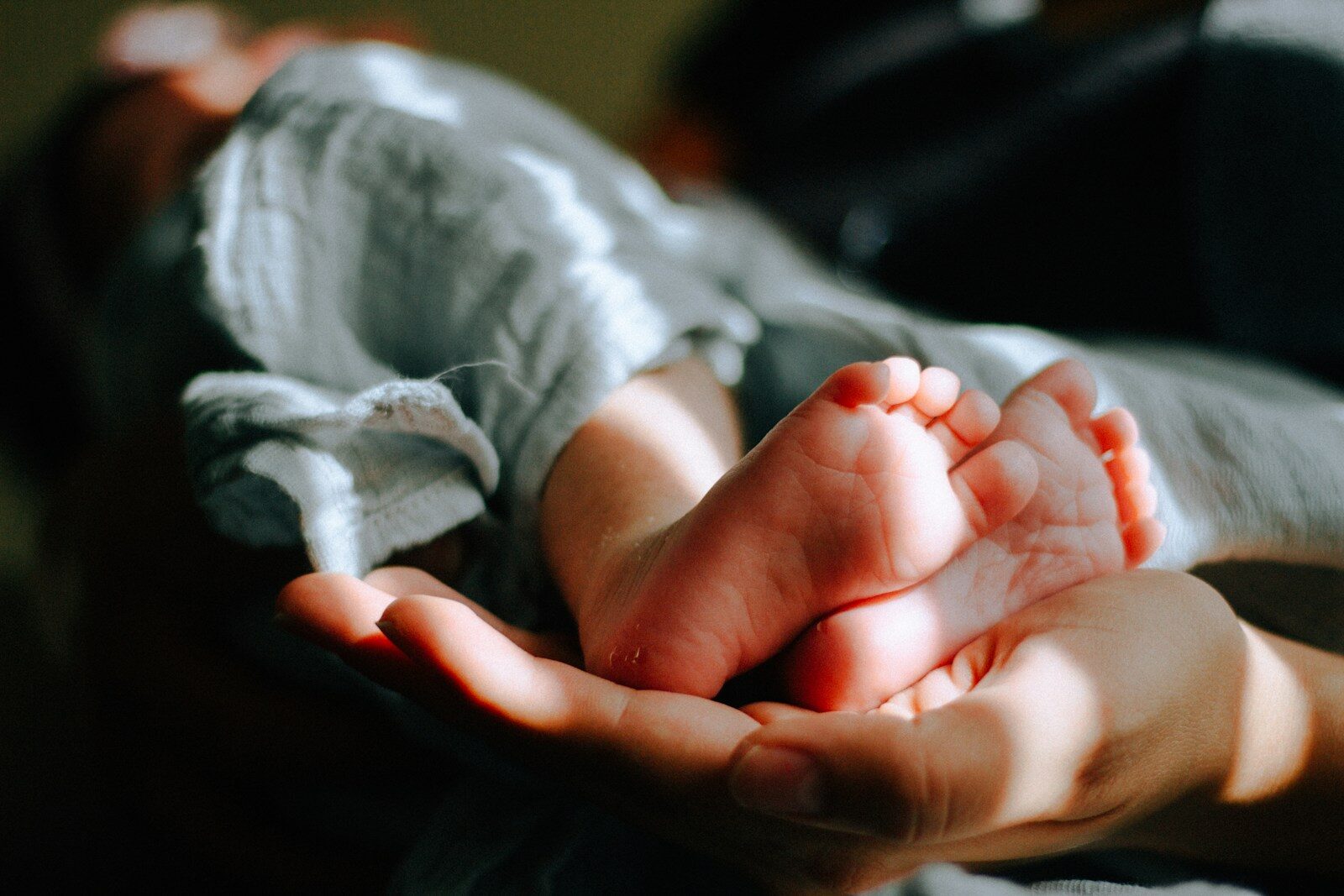
We have a new grandson! — Ezekiel Bennett Wright — a bundle of cuteness and joy and fresh sermon illustrations.
Amy and Bennett were pretty calm for the birth of their second. Maybe too calm. On the morning of July 1, they waited for Chick-fil-A to open at 6:30, ate a little breakfast, cruised to the hospital, strolled in sometime after seven. But before they reached the elevator, the attendant called for a wheelchair. Once in the room, the nurse calmly called the team, we need a baby bed in here—we are having a baby.
The mystery and miracle of childbirth is indescribable. First breath. First cry. First touch of skin. First milk. First sight of those who’ve loved you for nine months. First everything.
Born Anew
Jesus must have had all this and more in mind when the Jewish teacher Nicodemus snuck in a nighttime appointment with Jesus. At first reading, the dialogue in John 3 seems odd, as if Jesus changes the subject:
Nicodemus: “We know that you are a teacher from God for no one can do these signs you do unless God is with him.”
Jesus: “Truly, truly, I say to you, unless one is born again he cannot see the kingdom of God.”
Nicodemus speaks about what he and the religious leaders think they know. Jesus speaks about what Nicodemus doesn’t know—what he can’t know by any natural means.
Even Jesus couldn’t explain the kingdom to Nicodemus. He could only invite him to experience the kingdom.
You can’t explain the kingdom to someone any more than you can explain to an unborn child what it is like to be on earth. When all you know is amniotic fluid, air makes no sense.
It doesn’t have to be a dramatic or sudden event, but entering the kingdom of God is an experience, a happening, a real move into a new realm.
Even Jesus couldn’t explain the kingdom to Nicodemus. He could only invite him to experience the kingdom.
Born into a New Realm
I asked Bennett if little Zeke cried right away and my son laughed and said the baby cried on the way out. He poked out his head, looked around and wailed.
I had never really thought about a newborn’s lungs. It’s stunning. While in mom’s tummy, Ezekiel got all his oxygen from the placenta through the umbilical cord. His lungs in utero were filled with fluid and essentially bypassed.
Something mind bending started before the baby was born. As labor began, stress hormones signaled the cells lining the lungs to stop secreting fluid and start absorbing it. Some of the lung fluid was squeezed out during birth but as Zeke took his first breaths, the magic happened. The alveoli expanded, the remaining lung fluid was absorbed into the lung tissue and carried away through lymphatic vessels.
And Zeke started breathing earth’s air.
No one could have described to him what it’s like to move from an environment of fluid to an atmosphere of air.
To be born is to experience a change of realm.
Paul described the transfer of realms as a domain change: Colossians 1:13 (ESV) — “He has delivered us from the domain of darkness and transferred us to the kingdom of his beloved Son….”
Before his birth, Zeke’s lungs were perfectly formed—but they had never breathed. They were made for another world. With one astonishing first breath, his lungs were activated for their created purpose.
He didn’t learn to breathe. He was given breath.
I think spiritual regeneration is like that—we enter a new realm, a new domain and we begin breathing in grace. We start seeing in the Spirit what had been veiled from our dim, sin-clouded eyes.
I think of Joe Mettle’s well-known worship song: “This is the air I breathe / Your holy presence / Living in me.” “Inspired” means “breathed into.” It’s no coincidence that in both Hebrew and Greek, the word for “breath” is also the word for “spirit.”
To be “born again” is to be “born of the Spirit,” Jesus said. To be born anew into the kingdom of God is to be literally “in-spired”—filled with the Spirit. To be a Christian is to be someone who has been born into a new realm with a new source of spiritual oxygen.
It’s a move from not seeing to seeing.
It’s a move from “breathing” law to “breathing” grace.
It’s a move from the flesh to the Spirit.
He didn’t learn to breathe. He was given breath.
Gloriously Vulnerable
Ezekiel weighed in at 6 pounds 13 ounces, a keeper (but I can put on seven pounds with just a good Thanksgiving and Christmas!).
When 3½-year-old big sister Mia came to meet newborn Zeke at the hospital, she brought him a truck and other assorted toys. Unless you’ve seen it firsthand, it’s just hard to imagine how little and vulnerable a newborn is. They don’t come into the world ready to play with you.
But any surprise or disappointment over Zeke’s smallness and unreadiness to play with trucks faded when Mia got to hold her baby brother. The look on her face was a blend of delight, wonder, nervousness and “I can’t believe I’m holding a real baby doll.”
A baby comes into this world so small, vulnerable and needy that it’s a wonder any of them survive.
What can a baby do?
Cry.
They are very good at crying. It’s their primary language.
The first cry isn’t evidence something is wrong. It is evidence that life has begun.
You can’t blame them for crying. After all, they had nine months of perfect temperature, constant nourishment, peace and quiet, and floating. Then suddenly, they experience cold air, bright lights, loud noises, gravity, hunger and uncertainty.
I’d cry too.
The cry activates multiple regions of the mother’s brain within fractions of a second. When a mom hears her baby cry, oxytocin releases to encourage bonding. The baby’s cry also promotes the release of prolactin that supports milk production and dopamine that makes responding to the baby deeply satisfying.
What else can a baby do?
Drink milk.
They are very good at demanding milk and nursing over and over and over. In the early morning. In the mid-morning. In the late morning. At noon. In the early afternoon….
I say it again—isn’t it a wonder that these creatures survive at all when they come into the world and bring us nothing but their neediness—their cries and their constant hunger. Babies are quite inconvenient.
Babies are quite unable to contribute to the household.
And yet, we love them. Any halfway healthy parent loves that inconvenient, helpless baby with a tender and fierce love that is rooted in an unspoken, inviolable covenant.
And in their helplessness and vulnerability, the well-loved baby forms into a person destined to enter the world with grace and strength.
The first cry isn’t evidence something is wrong. It is evidence that life has begun.
How Trust is Born
To be born anew is to experience a relocation from one realm to another and it is to come into the new realm aware of our utter helplessness without God. To move from death to life, from law to grace, from flesh to Spirit is to discover one’s own radical vulnerability and to admit one’s inability to contribute to this new life.
When we are born into the kingdom of God, we come by none of our merits and then, in the arms of a loving God, we learn to trust.
The first and most important thing that any born again Christian discovers is that he or she is a child of God, loved not because of any intrinsic merit, but loved because God is love and God loves His children.
The psalmist saw into the genesis of security: Psalm 22:9 (NLT) — “… you brought me safely from my mother’s womb and led me to trust you at my mother’s breast.”
There, held warmly, fed generously, and loved unconditionally—there trust is born.
To be loved when you have nothing to contribute except your cries and your hunger proves to your soul that you are wonderfully valuable and in the arms of undeserved affection, you learn to trust. You become securely attached. Your faith grows.
It’s how you came into the kingdom. You didn’t get invited into the realm because you deserved it. You were invited in because God’s love was set upon you long before you were born.
And, in the moment of faith arising in your heart, you were born anew into a new atmosphere and, instantly, you were thrown upon the tender heart of God’s grace. There, in the unmerited and unquenchable love of God, you discovered your worth and began growing in faith.
Ezekiel means “God is my strength.” One day, this tiny infant will grow into a man who will be able to out-arm-wrestle me. But today, I can just about hold him in the palm of my hand. His strength is now, and always will be, not in his stature, but in the unstoppable grace of God.
We are never told explicitly what happened in Nicodemus’ heart. But we see him again after Jesus’ crucifixion.
John 19:39 (ESV) — “Nicodemus also, who earlier had come to Jesus by night, came bringing a mixture of myrrh and aloes, about seventy-five pounds in weight.”
The curious Pharisee who first spoke with Jesus under the cover of darkness courageously identified with the crucified Savior and helped bury Him.
I don’t know when it happened, and scripture doesn’t tell us for sure, but sometime after hearing Jesus’ mysterious invitation to be born again, Nicodemus was.
He breathed new air.
He became small and fell into the arms of God.
And he grew into a man of faith.
Welcome to the world, Ezekiel Bennett Wright. May grace always be the air you breathe and may God’s love always be your strength.
 English